


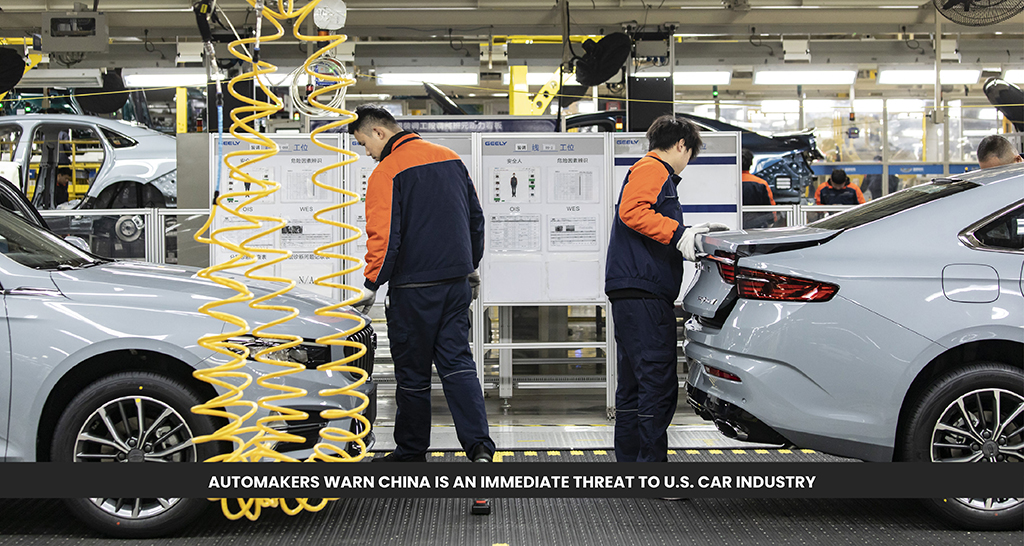
This week, major automakers delivered a surprisingly straightforward message to U.S. lawmakers: China poses a “clear and present threat” to the American automotive industry. This warning highlights the increasing worry that state-backed Chinese car manufacturers, particularly those leading the charge in the electric vehicle supply chain, could undermine American companies and significantly alter the global auto market.
The comments were made during a prominent congressional hearing focused on the future of vehicle manufacturing and the growing competition with China. Executives and industry leaders pointed out that Chinese automakers, supported by years of government subsidies, low-cost production, and strict control over battery supply chains, are quickly making their way into global markets with prices that Western companies simply cannot compete with.
Industry groups are calling on lawmakers to take strong action to stop Chinese companies from making inroads into the United States. They believe that if Chinese car manufacturers set up production facilities or tech hubs here, it could lead to unfair competition for American businesses and potentially weaken the country’s industrial foundation over time. Several representatives from automakers have raised concerns that Chinese firms might inundate the market with cheap electric vehicles, reminiscent of the challenges U.S. solar manufacturers faced a decade ago.
Executives pointed out that beyond just economics, there are significant national security issues tied to data collection, vehicle connectivity, and our dependence on foreign digital parts. They emphasized that today’s cars are more like rolling computers, which makes it crucial to protect vital software and communication systems from any potential foreign interference. Lawmakers were warned that vehicles outfitted with Chinese-made technology could, in the worst-case scenarios, be remotely disabled or manipulated during times of geopolitical strife.
Members of Congress from both sides of the aisle are sounding the alarm about the urgency of the situation. They pointed out that China has quickly risen to become the largest auto exporter in the world, leveraging aggressive production tactics and cost advantages to capture market share across regions, from Europe to South America. Lawmakers cautioned that if the U.S. does not implement strong defensive measures, we could end up relying on foreign electric vehicle technologies just as the global automotive industry is going through a major transformation.
During the hearing, a variety of proposals were on the table, such as implementing stricter import restrictions, introducing new regulations to prevent foreign-owned auto plants that get state support, and conducting more thorough reviews of automotive software and digital components. Additionally, some lawmakers advocated for incentives aimed at bolstering domestic electric vehicle manufacturing, emphasizing that safeguarding U.S. jobs and supply chains should be a top national priority.
The debate is happening at a pivotal time. Chinese automakers have made significant strides in battery technology, producing cost-effective electric vehicles, and securing access to essential raw materials like lithium and rare earth elements. On the flip side, U.S. automakers are grappling with increasing costs, a slower pace of EV adoption, and the urgent need to rethink their business models in a market that is changing rapidly.
Industry leaders have made it clear that they are not against global competition, but they believe it needs to be fair. They cautioned that if we do not act quickly with our policies, the U.S. could fall behind in an industry that is crucial for our economic security, technological edge, and the very identity of our manufacturing sector.