
Traditionally, farming meant land, farming experience, and heavy capital investment. Today, the digital era is altering this ecosystem by offering a whole new breed of business models which brings farm capacities within reach via tech-driven solutions. Farming as a Service is the next revolutionary trend that synergizes farming, AI, automation, subscriptions and data analytics to build highly scalable and profitable enterprises for entrepreneurs and investors.
Unlike conventional agriculture that requires possession of farms, agricultural equipment, and operational resources, FaaS helps businesses and farmers lease these assets on a service-based model. Whether it’s access to high-tech farm equipment on rent or to AI solutions that monitor crop conditions and automate farm activities, FaaS is paving the way for tech-enabled farming services. Entrepreneurs who want to catch the next wave of tech-driven business innovation will find a business model that seamlessly blends technology, ecological viability, and recurrent revenue streams.
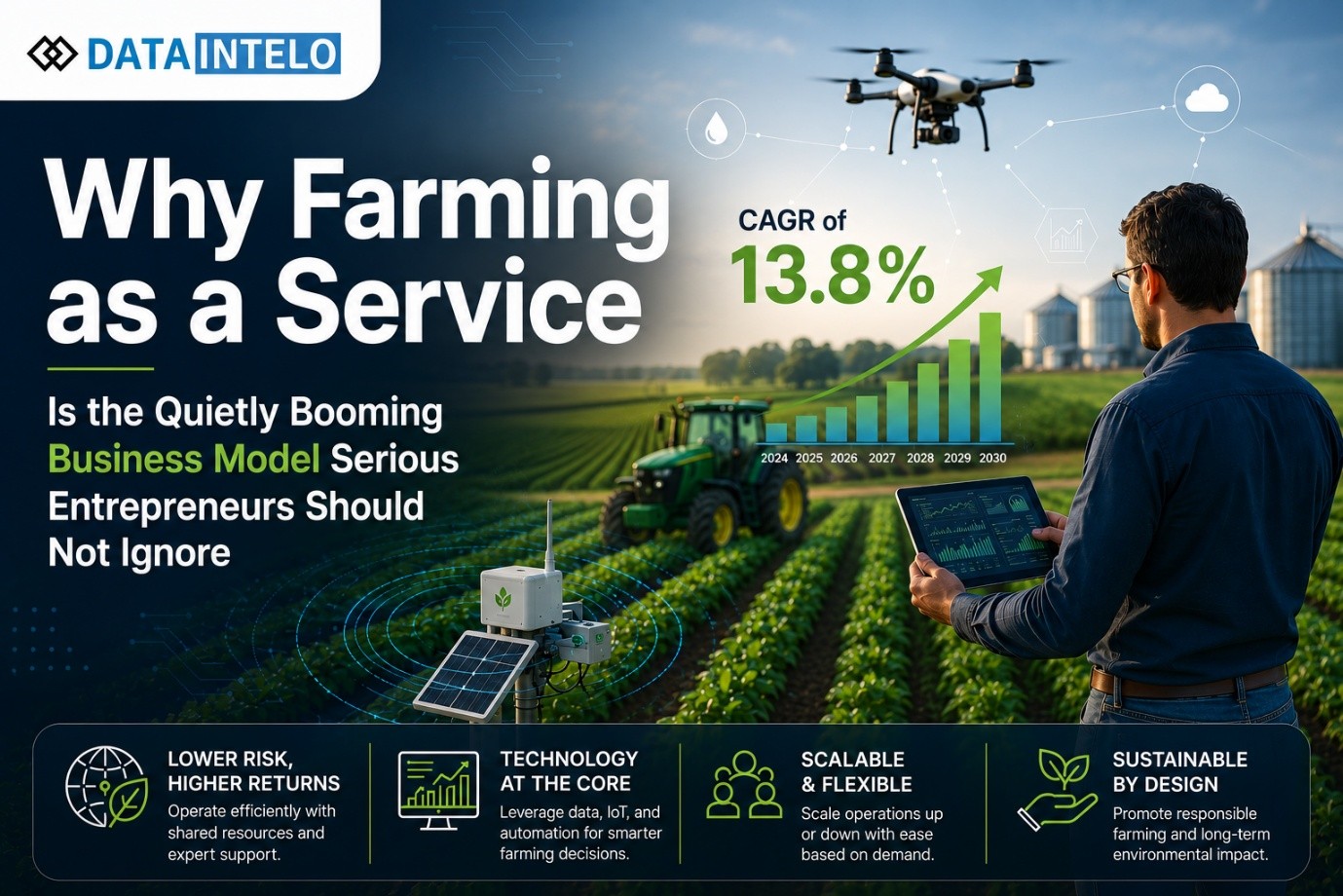
This model’s business potential continues to rise the Agriculture Technology-as-a-Service Market worldwide is expected to hit USD 47.6 billion by 2034 from USD 14.8 billion in 2025. This reflects a CAGR of 13.8% from 2026 to 2034 as per DataIntelo’s analysis. The increasing deployment of cloud-based farm management, AI solutions, IoT enabled monitoring systems, automation technology and advisory services for agriculture is leading to market expansion.
Precision agriculture techniques have proven to boost farm yields between 10-20%, while simultaneously lowering the cost of inputs by 15-25% through efficient usage. In addition to this, smart irrigation techniques can lower water usage between 20-40%.
The Rise of Agriculture as a Service-Based Business Model
The service economy has transformed industries such as transportation, healthcare, and software by shifting from ownership-based models toward subscription and on-demand services. Agriculture is now experiencing a similar transformation.
Farming as a Service provides access to advanced agricultural capabilities through flexible service models, including:
- Precision agriculture platforms
- Smart irrigation systems
- Drone-based crop monitoring
- Automated farming equipment
- Soil analysis services
- Artificial intelligence-based recommendations
- Digital marketplaces for agricultural resources
With this model farmers gain access to costly technologies and do not have to bear the investment and running costs associated with them. A complex piece of agricultural equipment may have price tags between $50,000 and more than $300,000 and it may not be feasible for the small to medium sized farmer to invest in it.
FaaS reduces this barrier by converting expensive equipment and technology into accessible services.
Why Entrepreneurs Are Paying Attention to FaaS
However, arguably, the greatest benefits of Farming as a Service are the opportunity to build technology companies in agriculture that can scale to an immense size. In a FaS model, it is possible for entrepreneurs to build a successful agricultural enterprise without owning any land at all, but by developing businesses that leverage:
- Equipment-as-a-Service platforms
- Digital farm management software
- Agricultural analytics solutions
- Drone monitoring services
- AI-powered crop advisory platforms
- Smart agriculture marketplaces
These businesses can generate multiple revenue streams through:
- Monthly subscriptions
- Equipment rental fees
- Data analytics services
- Technology licensing
- Consulting solutions
The recurring revenue structure makes FaaS attractive for startups because it provides predictable income opportunities similar to software-based business models.
Technology Is the Engine Behind Farming as a Service
The effectiveness of FaaS depends on advanced technologies that enhance productivity, productivity, and productivity.
Artificial Intelligence and Data Analytics
It has rapidly grown into one of the world’s most impactful agricultural technology. Artificial intelligence platforms draw data from a variety of sources such as:
- Satellite images
- Weather forecasting systems
- Soil sensors
- Crop monitoring devices
- Historical farming data
These systems help farmers make accurate decisions related to irrigation, fertilizer application, pest control, and harvesting schedules.
By converting agricultural data into actionable insights, AI enables entrepreneurs to develop platforms that deliver measurable value. Some precision agriculture applications can improve resource efficiency by 15%–30% while reducing unnecessary input usage.
For businesses, agricultural data is becoming a valuable digital asset that can support smarter and more profitable farming operations.
IoT and Smart Farming Systems
Connected devices are transforming farms into intelligent ecosystems. IoT sensors continuously collect real-time information about:
- Soil moisture
- Temperature
- Humidity
- Nutrient levels
- Weather conditions
These data points help smart irrigation solutions provide water for the crops when it is actually needed. With this solution, water use can be lowered by roughly 20-40% compared to existing methods. This presents the entrepreneur with possibilities in monitoring subscription-based services, remote controlled devices and cloud-based solutions.
Automation, Robotics, and Drone Technology
Labor shortages and increasing operational costs are accelerating agricultural automation.
Modern farming businesses are adopting:
- Autonomous tractors
- Robotic harvesting systems
- AI-powered drones
- Automated spraying equipment
Agricultural drones can analyzes large farming areas faster than manual inspection methods. Drone-based crop monitoring can reduce inspection costs by approximately 30%–50% while improving early identification of diseases and crop stress.
This has created a new entrepreneurial opportunity through Drone-as-a-Service models, where businesses provide advanced monitoring solutions without requiring farmers to purchase expensive equipment.
The Business Model Advantage of Farming as a Service
Farming as a Service creates a flexible and scalable business structure by replacing asset ownership with technology accessibility.
| Business Factor | FaaS Opportunity |
| Market Potential | AgTaaS expected to grow from $14.8 billion in 2025 to $47.6 billion by 2034 |
| Growth Rate | 13.8% CAGR during 2026–2034 |
| Productivity Improvement | Precision agriculture can improve yields by 10%–20% |
| Cost Reduction | Data-driven farming can reduce input expenses by 15%–25% |
| Resource Efficiency | Smart irrigation can reduce water usage by 20%–40% |
| Revenue Model | Subscription, rental, and technology-based income streams |
Entrepreneurship enabled individuals to construct enormous corporations without owning a significant part of the physical property being used in farming.
Leadership and Innovation in the Future of Agriculture
To start a successful FaaS company building is not only the high technology, it is necessary someone to lead, getting to know the problems for the farmers and designing solutions to bring benefit to all.
Future agricultural leaders must focus on:
- Developing affordable digital tools
- Building trust with farming communities
- Creating simple user experiences
- Establishing strategic partnerships
- Continuously improving technology platforms
Best performing companies are the ones which leverage technology with a sound agricultural foundation.
Sustainability: A Major Driver of FaaS Adoption
Sustainability is evolving from an obligation to an enormous business opportunity as our agricultural system faces enormous problems from climate change, limited resources, and a scarcity of water.
FaaS supports sustainable farming by enabling:
- Reduced water consumption
- Optimized fertilizer application
- Lower chemical dependency
- Better crop planning
- Efficient resource allocation
precision agriculture has been estimated to lower fertilizer use between 10 and 20% and produce equal or better yield. Sustainability, the “final frontier of entrepreneurship,” provides companies an edge in more than just environmentally friendly practices.
Challenges Entrepreneurs Must Address
Despite its strong potential, FaaS businesses must overcome several challenges:
- Limited technology awareness among farmers
- Rural connectivity limitations
- High technology development costs
- Need for localized solutions
- Data privacy concerns
The ability to offer inexpensive services, effective support, and appropriate coaching would also be a crucial step-in long-term stability for any firm.
The Future of Farming as a Service
It marks a new beginning in the domain of agriculture where sustainability meets with innovation and entrepreneurship closely. From being a system driven by ownership to the Farming as a Service, we are seeing a transition into an innovative ecosystem. Agriculture as a Service the AgTaaS sector is all set to take a giant leap and entrepreneurs stand to benefit in forming scalable businesses that are solving agricultural challenges with sustained value creation.
Future may be led not by those who own the farms, but the next set of agricultural ventures that develop smart platforms, digital solutions and intelligent systems to foster smarter, more efficient, and more profitable farms. With further advances in artificial intelligence, robotics, automation and smart farming technology, Farming as a Service will stand to emerge as one of the most defining business models in the future of farming.
Reference: https://dataintelo.com/report/global-agriculture-technology-as-a-service-market