
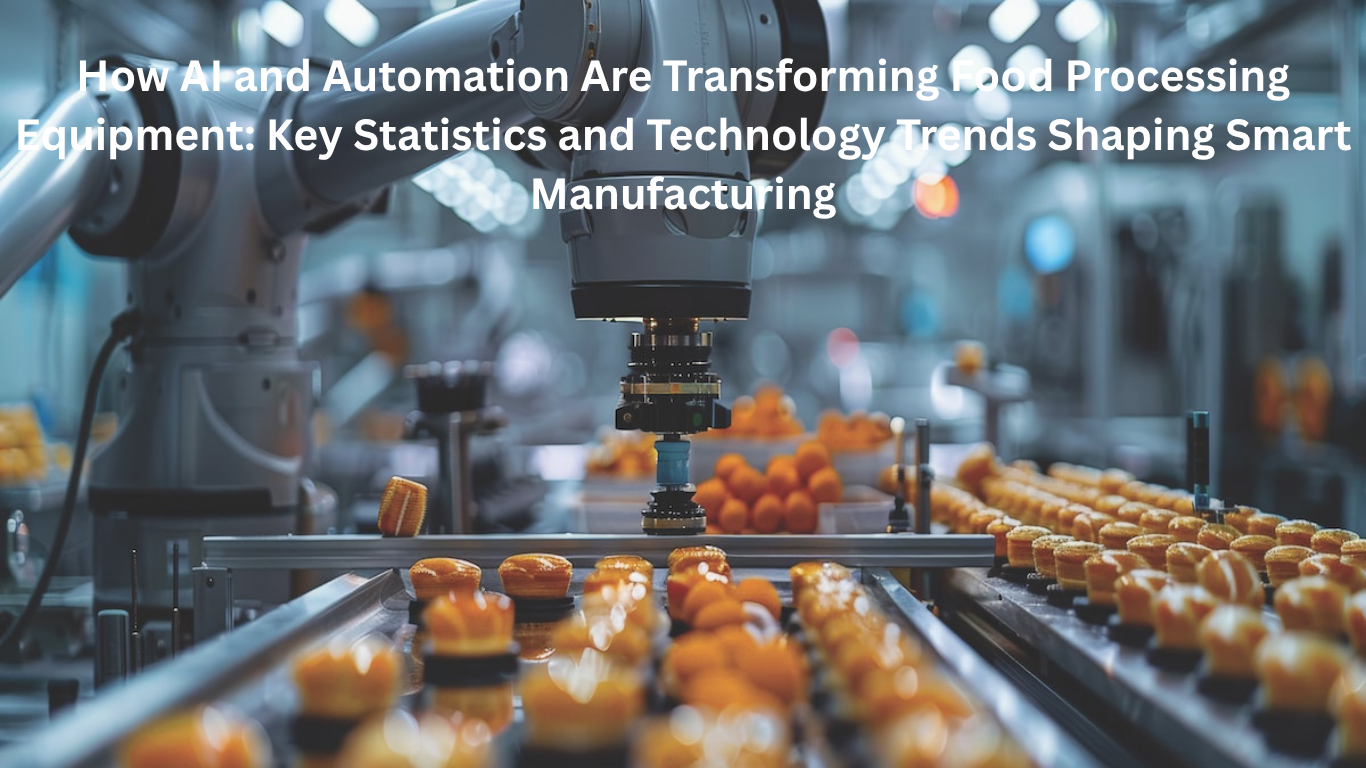
The food processing industry is entering a new era of intelligent manufacturing as artificial intelligence (AI), robotics, Industrial Internet of Things (IIoT), machine vision, and automation technologies reshape production operations. Food manufacturers worldwide are investing in smart equipment to improve efficiency, reduce costs, enhance food safety, and meet growing consumer expectations for quality and transparency.
Rising labor costs, supply chain challenges, strict regulatory requirements, and sustainability pressures are accelerating the adoption of automated food processing systems. Unlike traditional machines that perform repetitive tasks, AI-powered equipment can analyze real-time production data, predict operational issues, and automatically optimize manufacturing processes.
As per DataIntelo’s analysis, the global food processing equipment market is estimated at USD 98.5 billion in 2025 and is anticipated to expand to USD 170.4 billion by 2034, representing a compound annual growth rate (CAGR) of 6.2%. This expansion highlights the increasing demand for advanced processing solutions powered by digital technologies, automation, and smart factory innovations.
AI is Creating Intelligent Food Manufacturing Systems
Artificial intelligence is becoming a critical technology for modern food processing facilities. AI-enabled machines use sensors, machine learning algorithms, and advanced analytics to monitor production conditions and make automated adjustments.
These intelligent systems analyze factors such as:
- Raw material quality
- Temperature levels
- Moisture content
- Production speed
- Equipment performance
- Product consistency
For example, AI-powered processing systems can automatically adjust cooking temperatures, mixing speeds, or packaging settings based on real-time production conditions. This reduces human error while maintaining consistent product quality.
Manufacturers implementing AI-driven optimization have reported 20–35% improvements in production efficiency, 15–25% reductions in waste, and improved resource utilization across processing operations.
Key Industry Statistics
| Metric | Value |
| Global Food Processing Equipment Market (2025) | USD 98.5 Billion |
| Projected Market Size (2034) | USD 170.4 Billion |
| CAGR (2025–2034) | 6.2% |
| AI Productivity Improvement | 20–35% |
| Food Waste Reduction | 15–25% |
| Predictive Maintenance Downtime Reduction | 30–50% |
| AI Inspection Accuracy | 98–99% |
| Energy Savings Through Automation | 10–25% |
Automation is Improving Manufacturing Efficiency
Automation has become one of the strongest drivers of productivity in food manufacturing. Modern facilities are adopting automated conveyors, robotic systems, smart packaging equipment, and programmable control systems to streamline operations.
Automated processing lines help companies achieve:
- Higher production capacity
- Reduced dependency on manual labor
- Improved product consistency
- Faster processing cycles
- Lower operational expenses
Studies indicate that advanced automation can increase production efficiency by 20–40% while reducing repetitive labor requirements by 30–50%.
For food manufacturers, automation is not only about replacing manual tasks. It enables employees to focus on higher-value activities such as quality management, process improvement, and equipment supervision.
Predictive Maintenance Reduces Equipment Downtime
Unexpected equipment failure can create significant financial losses for food manufacturers. AI-powered predictive maintenance is changing how companies manage machinery by identifying potential problems before breakdowns occur.
Smart sensors continuously monitor equipment conditions, including:
- Motor vibration
- Temperature changes
- Electrical performance
- Pressure levels
- Mechanical wear
Machine learning algorithms analyze these signals and provide early warnings about possible failures.
Companies using predictive maintenance solutions can achieve 30–50% reductions in unplanned downtime, 20–40% lower maintenance costs, and improved equipment reliability.
This approach allows manufacturers to move from reactive repairs to proactive equipment management.
Computer Vision Improves Food Quality Control
Food quality inspection is becoming faster and more accurate through AI-powered computer vision technology. Traditional manual inspection methods can be inconsistent, especially during high-speed production.
Modern vision systems use high-resolution cameras and deep learning algorithms to identify:
- Defective products
- Foreign materials
- Incorrect packaging
- Labeling errors
- Color variations
- Size differences
Advanced AI inspection systems can analyze hundreds of products per minute while achieving 98–99% accuracy.
This technology helps manufacturers improve food safety compliance, reduce product recalls, and maintain consistent quality standards across large-scale production lines.
Robotics is Transforming Food Processing Operations
Robotics is playing an increasingly important role in food manufacturing. Robots are now used for ingredient handling, sorting, packaging, palletizing, and material transportation.
Modern robotic systems improve:
- Processing speed
- Workplace safety
- Production accuracy
- Labor efficiency
High-speed robots can perform more than 100 operations per minute in certain applications while maintaining precise handling standards.
Collaborative robots, also known as cobots, are gaining popularity because they can safely work alongside human employees. These systems help manufacturers overcome labor shortages while improving productivity.
IIoT Enables Connected Smart Factories
Industrial Internet of Things technology connects machines, sensors, and software platforms into a unified manufacturing network.
A smart food factory can use thousands of connected sensors to collect real-time information about:
- Equipment performance
- Production output
- Energy consumption
- Processing conditions
- Maintenance requirements
This data enables managers to monitor operations through digital dashboards and make faster business decisions.
Connected factories improve visibility, reduce inefficiencies, and create opportunities for continuous operational improvement.
AI Supports Sustainability and Waste Reduction
Sustainability has become a major priority for food manufacturers. AI helps companies reduce environmental impact by optimizing production processes and minimizing resource waste.
AI-driven systems improve:
- Ingredient utilization
- Inventory planning
- Production scheduling
- Energy management
- Water consumption
Manufacturers using smart optimization technologies can reduce food waste by 15–25% and improve resource efficiency by identifying areas where materials and energy are being lost.
Smart energy management systems can also reduce electricity consumption by 10–25% through automated control of refrigeration, heating, and production equipment.
Future of Smart Food Manufacturing
The future of food processing will be shaped by advanced technologies that make factories more autonomous and connected. Key innovations include:
- Edge AI computing
- Digital twin technology
- Autonomous mobile robots
- AI-based supply chain forecasting
- Blockchain-enabled traceability
- Cloud manufacturing platforms
- Generative AI production planning
These technologies will allow manufacturers to create flexible production environments capable of responding quickly to changing market demands.
The Business Impact of AI-Powered Food Processing
AI and automation are transforming food processing equipment into intelligent manufacturing platforms that improve efficiency, quality, and sustainability. From predictive maintenance and computer vision to robotics and IIoT connectivity, these technologies are helping companies reduce costs while creating safer and more reliable food production systems.
With the global food processing equipment market projected to grow from USD 98.5 billion in 2025 to USD 170.4 billion by 2034, businesses investing in smart manufacturing technologies will gain a significant competitive advantage. AI-driven automation is becoming more than a technological upgrade—it is a strategic business investment shaping the future of global food manufacturing.